


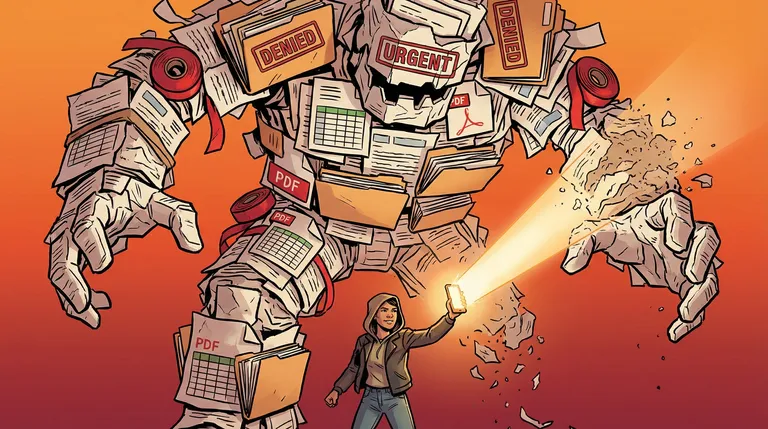
I didn’t start ioZen because I saw a market opportunity. I started it because I was angry.
A patient fills out a 47-field intake form. She makes a mistake on field 23. She gives up. She doesn’t get care.
But that’s the dramatic version. Here’s the everyday version:
You want a quote from a service provider. Three emails, a phone call, and a PDF you have to print and sign. You join a gym and spend 20 minutes on paperwork before you can work out. You sign up for a club and the onboarding makes you wonder if it’s worth being a member. Your small business applies to be a vendor and you submit the same information to three different portals.
And then there’s sales. A potential customer is interested in your product. They fill out a contact form. Someone from your team emails them back two days later with a questionnaire. The customer fills it out. Your team builds a quote in a spreadsheet. Emails it as a PDF. The customer has questions. More emails. A revised quote. Another PDF. By the time the deal closes, three weeks have passed and both sides are exhausted. Half the time, the customer just goes with whoever answers faster.
Bureaucracy isn’t a government problem. It’s not just for hospitals and insurance companies. It’s the friction hiding in every process that makes you think: why is this so hard?
It kills time. It kills focus. It stops people from doing what actually matters to them.
That’s my enemy.
Why an enemy, not a vision?
Most startup advice tells you to start with a vision. Define where you’re going. Paint the future. I think that’s backwards.
A vision is abstract. An enemy is visceral. A vision lives in a pitch deck. An enemy wakes you up at 5 AM.
I didn’t have a detailed product roadmap when I started. I had a deep frustration with how the world collects information and processes work. So I wrote this on the ioZen About page:
Liberate humanity from bureaucracy. This is not a tagline. It’s a declaration of war.
That sentence does more strategic work than any business plan I’ve ever written.
The fuel
Building a company is hard. There are mornings when the code breaks, the users haven’t shown up yet, and the bank account looks thin.
On those mornings, “I’m building a SaaS platform” doesn’t get me out of bed. But thinking about the sales rep who lost a deal because the quoting process took three weeks? That does. Thinking about the new member who regretted joining because onboarding felt like a punishment? That does.
Anger gets a bad reputation in business. We’re supposed to be calm, strategic, data-driven. But there’s a kind of anger that isn’t destructive. The quiet, persistent kind. The kind that says: this shouldn’t be how the world works. And I’m going to do something about it.
That’s the fuel. It doesn’t run out the way excitement does. Excitement fades after launch day. The fight against bureaucracy? That’s a lifetime of work. And somehow that’s more motivating, not less.
Picking your battles
Having an enemy doesn’t mean fighting everything. It means knowing which battles matter.
A startup can spread itself across every front or put its full weight behind the fights that count. The enemy gives you a filter. When an idea shows up, I ask one question: does this make life simpler for the person on the other end of the screen?
Sometimes the answer is obviously yes. Build it. Ship it.
Sometimes it’s a genuinely good idea that just isn’t our fight. A feature that would make ioZen more configurable but would add complexity for the end user. More options, more fields, more screens. That’s bureaucracy wearing a product hat.
Letting those go isn’t stubbornness. It’s discipline. You can respect an idea and still recognize it belongs to someone else’s war. The courage to say no is just as important as the courage to build.

The community you didn’t expect
Here’s the part I didn’t plan for.
When you declare your enemy publicly, something happens. People who share your frustration find you. Not just customers. Allies.
Users don’t just send feature requests. They send stories. “My clients abandon our quoting process halfway through.” “New members drop out during onboarding.” “We lose 40% of applicants before page 2.” “Our sales cycle is 3 weeks when it should be 3 minutes.”
These aren’t complaints. These are people who understand the fight. They’ve been living it longer than I have, from angles I’ve never seen. The sales team that loses deals because their quoting flow is too slow. The community manager whose members never complete registration. The HR team that can’t figure out why good candidates disappear.
That changes how you listen. Feedback stops being noise you have to manage. It becomes intelligence from the front lines. Sometimes a user spots a battle I completely missed. Sometimes they show me that what I thought was the enemy was actually something different, something deeper.
The enemy keeps you focused. The community keeps you honest. You need both.
Your turn
I’m not saying every startup should declare war on something. But I am saying this: if you don’t know what makes you angry about the status quo, you might not care enough to survive the hard parts.
The hard parts will come. The code will break. Users will be slow to arrive. Money will be tight. Your friends will ask when you’re going to get a “real job.”
On those days, a vision statement won’t carry you. But a fight will.
So ask yourself: what’s broken? What process made you think “why is this so hard?” last week? What would you work on even if nobody was watching?
That’s your enemy. Name it. Make it personal. Say it out loud.
The people who feel the same way will find you. And you won’t have to fight alone.
Tags: